Craft history
Khayamia textile work from Cairo's tentmaker tradition
Under a vaulted arcade in the old city of Cairo, a handful of tentmakers keep alive one of the Islamic world's most intricate textile traditions — a practice of hand-cut cotton appliqué whose roots in ceremony and pilgrimage reach back for centuries.
The Street of the Tentmakers
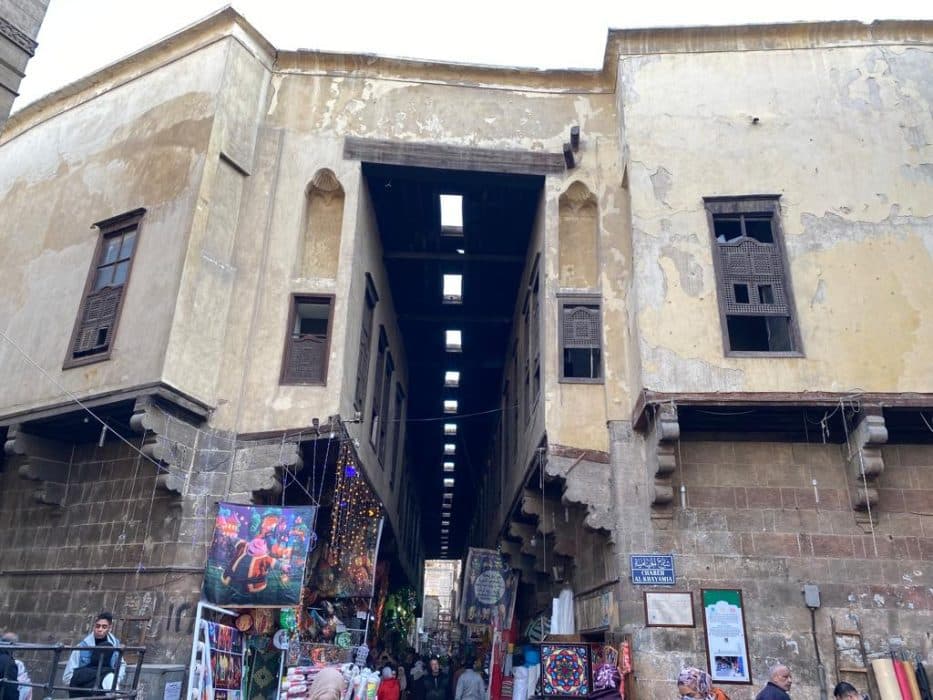
Sharia al-Khayamia — Tentmakers' Street — runs for a single block beneath a vaulted arcade in al-Darb al-Ahmar, the historic quarter of Islamic Cairo just south of Bab Zuweila. The covered market street — the Qasaba of Radwan Bey — was built around 1650, during the Ottoman period, by Radwan Bey, who held the title Amir al-Hajj, commander of the pilgrimage. Its shops historically provisioned the Hajj caravans bound for Mecca, and it remains the only surviving historic covered market street in Cairo. The appliqué tentmaking tradition itself is older: ceremonial tents worked in the same hand-cut geometry graced the courts of the Fatimid, Mamluk, and Ottoman dynasties for centuries before the street existed.
Today the arcade still shelters a small number of workshops — roughly twenty to thirty remain active. From the street you hear the needle pulling thread before you see the work: a rhythm of small percussions against taut cotton. Inside, bolts of white fabric hang from ceiling hooks, waiting to become the vivid geometric panels that cover pharaonic-revivalist pavilions, Sufi ceremony tents, and collectors' walls.
The trade survived Ottoman patronage, colonial indifference, and the decline of the pilgrimage caravan economy by adapting — smaller, more intimate pieces for homes and galleries — while never relinquishing the underlying hand-cut geometry that makes each panel legible as Khayamia from across a room.
A Living Tradition
Khayamia is not museum craft. The workshops on Tentmakers' Street are active businesses, receiving commissions from across Egypt and increasingly from abroad. The shift from tents to wall panels accelerated in the mid-twentieth century when the state began procuring decorated pavilions for national ceremonies. Private collectors followed.
The craft is widely recognised as endangered living heritage and the subject of active preservation efforts. A small number of workshops remain, though some have drawn new apprentices in recent years — a sign that the tradition, even under demographic pressure, continues to pass between generations.

The ability to hold the geometry in the body — in the hand and eye rather than the measuring tool — is the skill that separates a craftsman from a journeyman. My father taught me, and his father taught him. The hand remembers what the mind forgets.
Master tentmaker, Sharia al-Khayamia, Cairo
The Stitch
Every Khayamia panel begins with paper. The tentmaker draws the composition freehand — or from a template passed down through generations — then cuts each colour shape from cotton using small, pointed scissors with the confidence of a calligrapher. No two cuts are identical; the tremor of the hand is the mark of the maker.
The cut pieces are layered onto a backing cloth using the appliqué technique: each shape is turned under at the edge and whip-stitched or blanket-stitched in place with cotton thread dyed to match or contrast. A single medium panel — roughly 60 × 90 centimetres — may take forty hours of uninterrupted work.
Natural dyes were once standard: madder for crimson and terracotta, weld for yellow, indigo for deep blue, pomegranate rind for warm ochre. Today synthetic dyes are more common in everyday production, though the traditional palette remains the reference point for the craft's colour language.

The Motif Families
Khayamia draws from four reservoirs of motif: the geometric (interlocking stars, rosettes, and hexagons derived from Fatimid and Mamluk architectural tile and woodwork); the floral (stylised lotus, arabesque vine, and the carnation patterns that entered via Ottoman Istanbul); the figurative (pharaonic processional friezes, Nubian village scenes, felucca sails on the Nile); and the calligraphic (Quranic verses and bismillah borders rendered in Kufic or Thuluth script).
The geometric vocabulary is the most demanding. A twelve-pointed star drawn only with compass and straight-edge must close to within a millimetre across a panel two metres wide. Errors accumulate across a composition in ways that are invisible in isolation and devastating when the finished piece is hung flat.
Figurative panels were historically considered secular and domestic; calligraphic work carried ceremonial weight. Collectors today seek both, often commissioning a panel that combines a geometric border with a central figurative cartouche — a synthesis that is itself a product of the tradition's ongoing conversation with new audiences.